
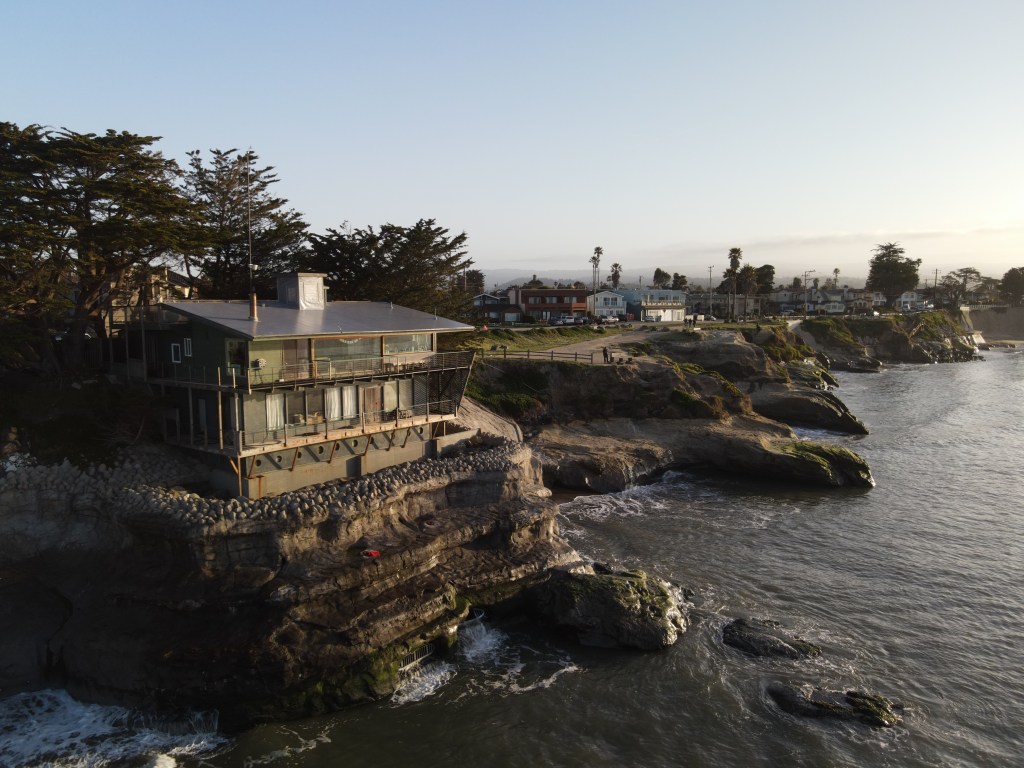
Pleasure Point, Santa Cruz
Perched above the waves at Pleasure Point is one of Santa Cruz’s most recognizable houses.
It belonged to Jack O’Neill, the legendary surfer and wetsuit pioneer whose innovations helped transform surfing from a warm-water pastime into a year-round sport.
O’Neill was also an advocate for ocean conservation. In 1996, he founded O’Neill Sea Odyssey, an educational program introducing young people to marine science and environmental stewardship.
His home overlooks a stretch of coastline that remains largely unchanged: an open coastal bluff near the surf breaks at Pleasure Point, including an area locally known as the Dirt Farm.
That landscape recently became the center of a controversy involving a proposed surfer statue, public opposition, and an exemption from California’s environmental protection law.
The outcome offers an interesting perspective on changes now reshaping environmental review throughout California.
The Statue and the Dirt Farm
In April 2026, Santa Cruz County approved a proposal to install a large bronze statue honoring women surfers along East Cliff Drive, adjacent to the area known as the Dirt Farm.
The proposed installation included the statue, three benches, and landscaping on approximately 650 square feet of coastal bluff.
The county determined that the project qualified for a categorical exemption under the California Environmental Quality Act (CEQA), specifically Section 15303 of the CEQA Guidelines, which covers certain small construction projects.
That determination allowed the project to proceed without preparation of a traditional CEQA environmental study.
But residents were not convinced that a large sculpture belonged on one of the remaining natural stretches of East Cliff Drive.
Opposition grew over concerns about coastal erosion, public access, views, and the character of the bluff. A grassroots campaign, Save the Dirt Farm, organized residents who wanted the area preserved.
On April 15, an appeal of the Zoning Administrator’s approval was filed on behalf of Bill O’Neill, Jack’s brother who helped run the wetsuit manufacturing business.
The proposal was headed for a Planning Commission hearing.
When Jack O’Neill’s Legacy Entered the Argument
During the controversy, a member of the public invoked the legacy of Jack O’Neill in making the case for preserving the Dirt Farm.
The argument was about more than the statue.
The coastal landscape itself, its association with surfing history, and its connection to the O’Neill family raised questions about whether the area deserved consideration for historical preservation.
The historical argument introduced another dimension to a controversy already attracting considerable public attention.
Five days later, on May 26, 2026, the applicant withdrew the proposal, just one day before the scheduled appeal hearing. The appeal was never heard.
Jack O’Neill was no longer there to defend the coastline. But his legacy was.
The Dirt Farm controversy illustrates an important distinction: a CEQA exemption does not necessarily eliminate other land-use requirements, appeal rights, or public opposition.
But California is expanding exemptions that can remove some of those opportunities.
What does that mean for communities trying to protect the places they value?
What Is CEQA?
The California Environmental Quality Act was enacted in 1970 to require public agencies to consider the environmental consequences of their decisions.
For projects subject to CEQA, the law can require agencies to identify significant environmental impacts, consider mitigation measures, and examine alternatives before granting approval.
CEQA also provides opportunities for public participation.
Residents can review environmental documents, submit comments, question findings, and, when appropriate, challenge an agency’s compliance with the law.
CEQA does not give the public an automatic veto over development. But it creates a process through which environmental consequences must be examined and public concerns considered.
Over the years, California has established numerous exemptions for projects lawmakers or regulators have determined should not require the full environmental review process.
The statue at Pleasure Point relied on one of those existing exemptions.
In 2025, California significantly expanded the exemptions available to housing developers.
What Did AB 130 Change?
On June 30, 2025, Governor Gavin Newsom signed Assembly Bill 130, creating a new statutory CEQA exemption for qualifying urban infill housing developments.
The law, codified in Public Resources Code Section 21080.66, provides that CEQA does not apply to any aspect of an eligible housing development project, including required permits, approvals, and public improvements.
Its purpose is to accelerate housing construction by reducing environmental review requirements and the delays and litigation that can accompany them.
The change is significant.
Under the traditional CEQA process, projects may require environmental studies, public comment periods, and consideration of alternatives or mitigation measures.
Under AB 130, a housing development that meets the statutory requirements can proceed without that project-level CEQA review.
Unlike the categorical exemption used for the surfer statue, AB 130 establishes a statutory exemption with its own eligibility requirements.
The exceptions that apply to categorical exemptions — including the historical-resource exception discussed in the Dirt Farm controversy — do not automatically apply to AB 130.
The question becomes whether the housing development qualifies for the statutory exemption in the first place.
Which Housing Projects Qualify?
AB 130 does not exempt every housing development in California.
Generally, the law applies to qualifying residential or mixed-use developments on urban infill sites of no more than 20 acres.
For projects proceeding under the Builder’s Remedy, the site-size limit is four acres.
Projects must satisfy additional requirements involving location, prior or surrounding urban development, minimum residential density, and consistency with applicable planning and zoning rules.
The statute also includes restrictions involving certain environmentally sensitive properties and the demolition of historic structures previously listed on qualifying registers.
Tribal consultation requirements and other environmental safeguards remain.
A project that fails to satisfy the statutory conditions cannot rely on the AB 130 exemption merely because it proposes housing.
Nor does AB 130 eliminate independently applicable federal environmental laws, coastal requirements, or other land-use regulations.
Nevertheless, for projects that do qualify, the exemption substantially changes the approval process.
Can Residents Still Challenge a Development?
CEQA has historically provided communities with opportunities to examine environmental consequences, challenge official findings, and hold public agencies accountable.
By expanding exemptions and streamlining approvals, California is narrowing those opportunities for qualifying housing developments.
Residents may still object, but their objections carry less procedural weight when the law leaves local officials little discretion to reconsider a project.
The Bottom Line
The Dirt Farm controversy offers a useful reminder of what public participation can accomplish, but California’s environmental review laws are changing.
AB 130 allows qualifying urban infill housing developments to bypass traditional CEQA review, reducing delays while also narrowing opportunities for environmental challenges.
The law retains eligibility requirements and other protections. But it changes the role the public can play in determining how developments proceed.
At Pleasure Point, the Dirt Farm remains open, and Jack O’Neill’s house still overlooks the same stretch of coastline.
But the story leaves us with a question worth considering as California continues to streamline development:
When environmental review is removed, what remains of the public’s ability to protect the places it values? What would Jack think?
More California housing law from The Nub
- California Builder’s Remedy Explained: What It Is and How It Works
- California ADU Laws 2027: Can You Build Two Backyard Homes?
- California SB 79 Explained: New Housing Rules Near Transit