
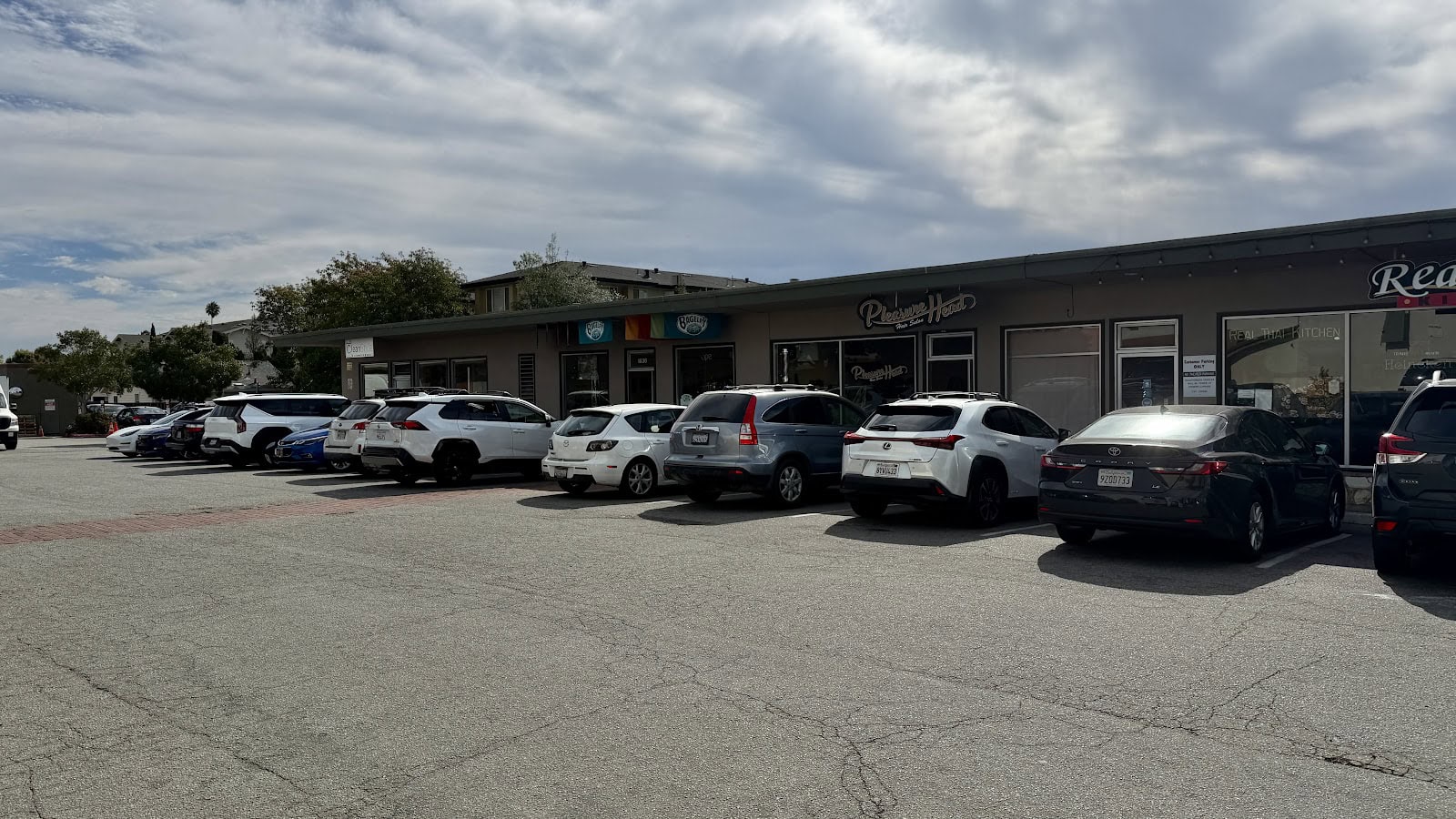
As the city doubles residential parking permit fees and restricts permits for certain new developments, Workbench’s proposed Bright Plaza raises a basic question: Who will absorb the parking demands of new housing?
At the intersection of Soquel and Seabright avenues, a neighborhood shopping center has become the center of a much larger debate over housing, transportation, and the future of Santa Cruz.
The property at 1214 Soquel Avenue, currently home to businesses including Ace Hardware, The Bagelry, and Akira, is the subject of two preliminary development proposals submitted by local developer Workbench.
One envisions a six-story senior living facility with 173 units. The other proposes 281 affordable housing units, also in a six-story building. Both include approximately 5,000 square feet of ground-floor commercial space.
Neither proposal has been approved. The projects are in the preliminary application stage.
But one issue already stands out: parking.
Two recent decisions by the Santa Cruz City Council raise questions about how the city intends to accommodate additional housing while managing its increasingly limited street space.
Santa Cruz Changes Its Parking Rules
In October, the Santa Cruz City Council adopted two significant parking changes: doubling fees for existing permit holders while excluding residents of certain new developments from the permit program altogether.
Parking Permits Double in Price
On October 27, the City Council approved another parking-related measure.
Annual residential parking permit fees increased from $30 to $60 per vehicle, part of an effort to bring the city’s residential permit parking program closer to recovering its operating costs.
The increase applies to residents participating in designated permit parking programs, not to every Santa Cruz household.
Although the city has legitimate administrative and enforcement expenses, the timing illustrates a growing tension.
California housing policy increasingly allows residential construction without traditional parking minimums.
City Council Restricts Parking Permits
On October 13, 2026, the Santa Cruz City Council adopted Ordinance No. 2026-16, establishing new restrictions on preferential residential parking permits.
Under the ordinance, if a new development uses state-authorized parking reductions, its residents will generally be ineligible for residential, guest, and daily permits in the city’s preferential parking program.
The restrictions apply to qualifying new developments, not automatically to existing residents or every new apartment building.
Whether Bright Plaza ultimately falls under these restrictions will depend on its final development proposal and the applicable legal requirements.
The city is attempting to address an obvious concern: If developers are permitted to provide fewer parking spaces, residents of those buildings should not automatically be entitled to use neighborhood permit programs to make up the difference.
But the ordinance also exposes a limitation.
Restricting access to parking permits does not necessarily reduce the number of automobiles requiring parking.
Nor does it prohibit drivers from using streets where unrestricted public parking remains available.
California’s Housing Laws Change the Equation
Assembly Bill 2097 generally prohibits local governments from requiring minimum automobile parking for qualifying developments within half a mile of a major transit stop, subject to statutory exceptions.
The objective is to reduce construction costs, encourage public transportation, and support additional housing near established services.
The law does not prohibit developers from building parking. Rather, it limits local governments’ ability to require it.
Workbench has argued that Bright Plaza’s location near transit, shops, and services makes it an appropriate place for additional housing.
That argument has merit within the state’s broader transportation policy. Residents who live closer to their jobs and daily necessities may have less need to drive.
But proximity to services and transit does not, by itself, establish how many vehicles a particular development will generate.
The city’s recent parking decisions establish new rules for managing demand.
Whether those rules will adequately protect neighborhoods facing substantial redevelopment remains an open question. And at Seabright Plaza, that question is far from settled.